Reputation · 5 min read
Should a solo consultant's website say I or we?
Choose a voice that reflects who does the work. Explain your role, collaborators and capacity without pretending to be a larger firm.
Published
You are writing your consultancy website and “I” feels exposed. “We” sounds more established. You work with a designer sometimes, use AI to prepare drafts and hope to hire eventually. Perhaps that is enough to call yourself a team.
Start with what a buyer will actually receive. If you lead the calls, make the recommendations and deliver the work, “I” is usually the clearest voice for those commitments. A business name can describe the practice. “We” can describe a real group, provided the page makes that group and its role understandable.
The useful distinction is who takes responsibility for the assignment. A pronoun should help a buyer understand that relationship. It cannot solve a capacity problem or supply experience you have yet to earn.
Say who the buyer will work with
Consider an illustrative independent consultant helping expert service businesses plan a new offer. They lead the engagement themselves and review any AI-assisted preparation. A freelance designer sometimes joins for launch materials, under a separately agreed scope. This is a hypothetical business, with no client results implied.
An AI draft might describe it this way:
We are a full-service consultancy bringing together a multidisciplinary team to transform your business.
That wording introduces several expectations. A buyer could reasonably ask which disciplines are included, whether a team is available throughout and how much of the business the engagement covers. The consultant would have to qualify much of the opening description during the first call.
A more useful version could say:
I help expert service businesses decide which new offer to develop. I lead the working sessions and recommendations. If launch design is needed, I can propose a specialist collaborator and agree that work with you separately.
This version gives the buyer a relationship they can assess. They know who leads, what decision the work supports and where another person might enter. The design work remains a possibility until its scope and availability are agreed.
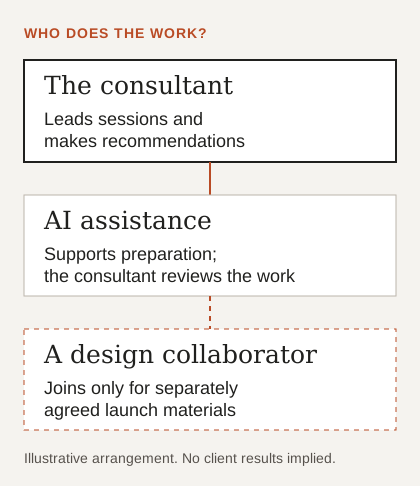
Illustrative roles for this example. A collaborator’s availability and scope still need agreement.
Direct access to the person making the recommendations can be a meaningful reason to choose a small practice. Explain how that access works. A founder appearing in the About photo while someone else conducts every meeting describes a different relationship.
Use I, we and the business name for different jobs
A solo business can have an institutional voice without pretending to employ a team. “The practice offers launch planning” describes an offer. “I lead your planning sessions” identifies the person doing the work. Those sentences can belong on the same page.
Use “we” when it refers to people genuinely delivering a shared commitment. A two-person practice can say who handles which work. A recurring collaboration can explain its arrangement. If the group changes by project, make that visible before a buyer assumes the people pictured are all included in their fee.
There is also a legitimate distinction between speaking as an organisation and claiming a delivery team. GOV.UK’s guidance on writing for user interfaces uses “we” for the service speaking and “I” for the user speaking. That convention serves government transactions. It shows why a pronoun alone cannot tell you an organisation’s headcount; a consultancy still needs to explain who will fulfil its promises.
You can build a brand that survives beyond its founder by defining its purpose, offer and standards other people can use. Future hiring is a reason to make those decisions clear. Describe today’s delivery honestly while you build toward that future.
Answer the concern behind looking too small
“Will they take me seriously?” can hide a practical buyer question. Can you handle the workload? Will they reach you when needed? What happens if you are unavailable? Would another supplier be better equipped for the assignment?
Nielsen Norman Group’s research on About Us content found mixed attitudes toward company size. Participants expressed concerns about small-company reliability and large-company helpfulness. The research supports addressing concrete concerns; it does not establish that one pronoun wins more consulting work.
For the illustrative consultant, a delivery note could explain:
I lead one offer-planning engagement at a time. We agree meeting dates before starting. There is no standing backup consultant; if I become unavailable, we discuss the effect on the agreed schedule.
Here, “we agree” refers to the consultant and client making a decision together. Publish that only if it describes the actual arrangement. Another practice might have reliable cover, parallel capacity or fixed response windows. State what exists and keep the promise consistent with the proposal.
Some buyers need continuous cover, several disciplines working at once or a larger delivery team. Their requirements may make your current practice unsuitable. Clear limits let you identify that mismatch early. Changing “I” to “we” leaves the underlying requirement unresolved.
Keep AI assistance separate from team size
AI may let one consultant prepare more material. It does not give the buyer a second accountable consultant, a replacement for an absence or an additional discipline with demonstrated expertise.
If you use AI to improve the website, give it the delivery facts before asking for a more confident voice: who leads, which work is included, when collaborators join and what remains outside the offer. Ask it to flag wording that implies extra people, capabilities or availability. Check those flags yourself.
The same principle applies to imagery. A real portrait can show the person a buyer will meet. An invented team photograph creates a staffing implication the business cannot explain. Use an accurate image, a relevant work sample or a clear illustration. Label an illustration when it could be mistaken for evidence of your actual team or results.
Your human direction should govern AI’s execution. A polished draft can help you express a decision you have made. Review any added promise against the business you are equipped to run.
Check the page through the first working meeting
Read the opening of your site and imagine the buyer arriving at the first working meeting. Who do they expect to see? Who do they expect to make recommendations? Which work do they think is included, and who do they expect to be available afterwards?
Compare those expectations with the actual assignment. Then ask a suitable prospect to read the page and describe the same things, before you explain what you intended. A mismatch gives you a specific correction to make.
Keep the customer situation on your homepage precise and the delivery relationship equally clear. You can present a small practice with confidence when you can explain its choices and keep its commitments. The next edit should make that business easier to recognise.